In today’s world of ultra-competitive sports, more and more parents are turning to private coaches to help their child excel. From an outsider’s perspective this might seem like a decision based purely on athletics, but what many people fail to realize is that when you find a great private coach, he or she will not only help your child on the field, but off the field as well. Finding a great private coach at an early age can establish a powerful relationship that enables the coach to help your child in multiple capacities.
One of the biggest benefits of a private coach, outside of athletic improvement, is his or her ability to help increase your child’s confidence. Most children lack confidence because they feel there is nothing particularly special about them; becoming a standout in their sport can change that and it will quickly become a point of pride for them. This feeling of pride and accomplishment can quickly crossover into all aspects of their life that may help cause a chain reaction that shifts their whole attitude for the better. This positive change of attitude can often lead to a better classroom work ethic as they now have experienced first hand that extra-work can lead to success and a feeling of accomplishment.
Parents often think (or would like to think) that their children will come to them with all of their problems, but the unfortunate reality is they won’t. Having an additional confidant can be a hugely helpful resource for your child. In addition, having them regularly interacting with someone who they aspire to be will help create motivation for them to work toward their goals. Unfortunately, children often ignore their parents’ advice. But if their coach, who they trust and respect, tells them that they need to concentrate on school as much as their sport to be a collegiate athlete, they’re more likely to listen.
This is not to say that all private coaches will have a profound positive affect on a child; like with anything not all private coaches are created equal and a bad one can even be detrimental. It is important that you are consistently communicating with your child to be sure that they’re not only improving from their session but also enjoying them. Good team coaches don’t necessarily make good private coaches, just like good players don’t always make good coaches.
A great private coach needs to be able to connect with their athletes and build strong rapport, as it is a very personal relationship and requires a deeper level of trust than a traditional athlete-coach relationship. If your child begins working with a private coach that doesn’t seem like a good fit, don’t waste time hoping things will improve; you need to move on quickly and begin looking for a new coach. Once you find that “perfect” private coach, you’ll quickly realize that the extra effort to find him or her was well worth it.
Next time you hear about someone you know hiring a private coach for their child, don’t jump to the conclusion that the decision was purely about athletics. If possible, talk with them about their experience and ask if the coach has had an impact on their child’s life in areas outside of sports. You may be surprised at their answer!
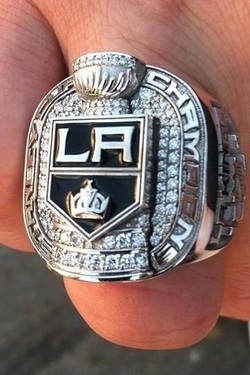
RUT Hockey player Ryan Scott had the opportunity to try on the Los Angeles Kings Authentic Championship Ring prior to the Kings-Chicago Blackhawks game as part of the club’s pre-game festivities in which the franchised raised their first Stanley Cup championship banner to the rafters in STAPLES Center. Scott who is a big part of RUT Hockey's mission got to try on the championship ring. Each Kings player received their Tiffany & Co. championship ring on the ice. Tiffany has created each championship ring as a lasting tribute to the LA Kings dedication and thrill of victory. This will mark the jeweler’s first creation of a NHL Championship ring.
The face of the ring includes 104 round brilliant pave set diamonds. The Los Angeles Kings crest sits atop the Stanley Cup and the text “STANLEY CUP CHAMPIONS” is set around the bezel.
The ring’s shanks celebrate the Kings’ historic 2012 season. The LA Kings iconic crown and player name in raised letters appear on one shank; and the LA Kings team name, the NHL logo, 16/4 record and year (2012) appear on the other shank.
| | Whether your sporting face paint, a mask or a bright purple wig, our fans love to prove their passion for RUT Hockey.
GO-RUT-GO
|
September 18, 2012 Sadly, but not surprisingly, the NHL lockout became official Saturday. It’s the third time in Gary Bettman’s career as commissioner the NHL has locked out the players, and the second time in the past eight years. MSF’s own Peter Stewart summarized the situation very well Sunday. The CBA negotiations are practically at a standstill. I doubt the NHLPA will concede any time soon. NHLPA Executive Director Donald Fehr has a history of standing firm and not giving in, and he’s done just that so far. Some players have already signed with other leagues. As much as fans, including myself, would like to watch our favorite players play, my guess is you don’t have the money or time to fly overseas to make that happen. So here are four ways to get your hockey fill without the NHL.
1.) Go See Your Local AHL Team I am sure minor league hockey will see a spike in attendance for as long as the NHL lockout goes on. NHL teams have already sent some of their players down to their affiliated AHL teams, so you have a very high chance to see NHL-caliber players for nearly half the price. If you’re a hockey fan, why wouldn’t you take advantage of that?
I’m already making plans to see some Chicago Wolves and Rockford Ice Hogs games this year. Nothing beats the talent and speed of the NHL, but there’s now way I am not getting my hockey fix this season. If you don’t know the nearest AHL team, take the time to find out and then buy some tickets, bring the family, and enjoy the game.
2.) Go See a College Hockey Game Another really fun alternative to the NHL is going to see some college hockey. Teams aren’t as spread out evenly (sorry West Coast) as in the AHL, but if you’re within driving distance, it’s completely worth it. I’ve only been to two college hockey games (both Notre Dame games), but I’ve thoroughly enjoyed the games both times. Most of the college venues are small, but that just adds to the college sports atmosphere, where all you hear is screams and chants from the student section. The rules are a little different from the NHL. I wasn’t aware there is no shootout after a five-minute, 5 on 5 overtime in the regular season, so you could imagine the surprised look on my face when the Notre Dame – Michigan State game ended at a 1-1 tie, but it’s still the same, great hockey I love.
3.) Start Your Own ‘Backyard’ Hockey League Every winter my friends and I play street hockey. We pool pour money together, usually $10-15 each, for new equipment such as goalie gear or a new net. We bring our own stick, and if we want to stay warm we wear some long pants, a cap, and gloves. It’s some of the most fun I’ve had in my life. Not only am I playing the sport I love, but I’m playing it with people I love. All you really need is 3 v 3, including the goalie. We’ve found out it works best with 2 forwards, 1 defenseman, and one goalie for each team. But work with what you got. I am still young and have the time and energy to do such things, but I highly recommend that you, at whatever age, find the time to get the “guys” or “gals” together for a few games of hockey. As much fun it is to watch hockey, believe me, it’s 10x more fun to play it.
4.) Buy NHL 13 EA’s NHL 13 is the perfect antidote for the possible lost 2012-13 NHL season. Video games may not be your forte, but if they are then NHL 13 is perfect for you. I managed to play a little bit of the game the past weekend, and I absolutely loved it. The game is a lot more realistic in the way the players move (EA calls it “True Performance Skating) and position themselves on the ice. The GM mode is spectacular. I didn’t get to play around with the GM Connected as much as I would have liked, but I did enjoy what I saw. I do recommend you put it on the hardest difficulty though. Winning the Stanley Cup easily every year, while seemingly fun, gets old after a while. Because of the lockout, Amazon (and other retailers) have lowered the price of NHL 13 from $60 to $50. ***** What other ideas do you have for hockey fans looking to get their fix during the lockout?
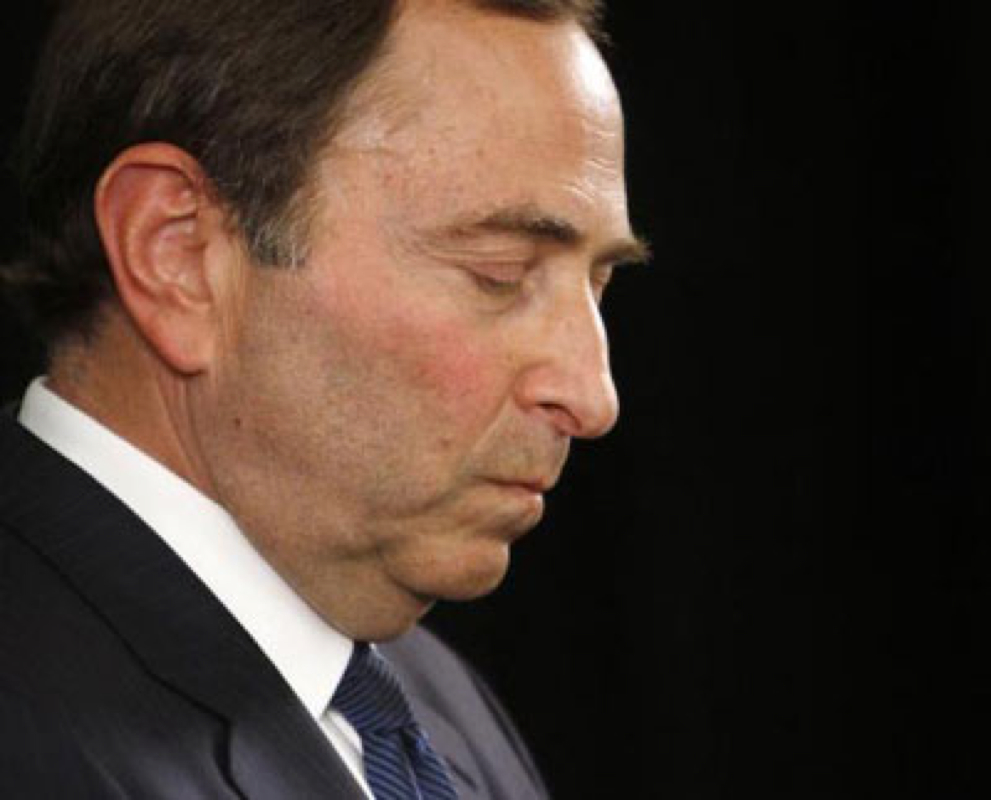
Head NHL commissioner looks discouraged after the lockout decision that has begun across the entire NHL.
What you’re about to see is a handshake line between teams comprised of players aged 10-12. The two teams — UBC Hornets and Richmond Steel (yeah, this is in Vancouver) — played last weekend, with the Hornets winning by a score of 5-4. That victory didn’t stop Hornets head coach Martin Tremblay from pulling off arguably the cheapest move in the history of handshake lines: The result? The kid that got tripped suffered a broken wrist and Tremblay was taken into custody by Royal Canadian Mounted Police. He was released without charges, but RCMP Sgt. Paulena Gidda said investigators are still considering charges of assault or assault causing bodily harm. Tremblay — who is 52 years old, by the way — reportedly claimed he slipped on some water and accidentally tripped the player, a pretty weak excuse given video evidence. Unsurprisingly, nobody’s buying his excuse, including the Steel team manager, Tammy Hohlweg. “Actually seeing it is horrifying,” she said after watching the video. “He should not be allowed around kids. No more coaching for this coach.” “If a coach is like that, the kids will feed off that – the kids will react and do that too.”
San Antonio, TX — A team comprised of local players from San Antonio, TX participated in a 7-game round-robin hockey tournament that spanned a weekend and concluded on Fathers day Sunday afternoon. The tournament took place in San Antonio, TX and represented seven teams from Houston, Dallas, and San Antonio. The boys played in the competitive division which consisted of Pro, College, and elite players. The Cankle had a strong showing with a record of 6-1 and beat the defending champion Dump team, 3-2 in shootout win, to capture the Alamo Hockey Classic win! RUT Hockey team member Ryan Scott, as well as Sean Miller, Patrick Grace, Doug Tresnack were named to the all-Tournament Team.
This marked an impressive showing to the San Antonio, TX community and marked the 1st championship for Team Cankle in the past 4 years. Each team member will have the honor to represent and share the Alamo Cup for two weeks to themselves and can represent however perceived. So be on the lookout in the local San Antonio community for autographs and picture taking.
_During the next few days, a lot of attention will be paid to the obvious differences between Martin Brodeur and Jonathan Quick -- most specifically their ages. A Stanley Cup Playoffs virtual newbie vs. a Cup veteran, Quick is the 26-year-old yin to Brodeur's 40-year-old yang, to be sure. Upon closer examination, however, it is the similarity in each goalie's approach to stopping the puck that is the most relevant reason for their success this season. The two goalies left standing this spring are among the most creative and unpredictable goalies in today's game. Their resulting dominance is no coincidence. In what is often a copy-cat league, the unorthodox styles of Brodeur and Quick may well serve as a tipping point in what may signal a new era in goaltending. Each goalie utilizes "old-school" reflexive techniques as a base, adding in modern butterfly play -- with Quick exhibiting more of the latter -- to be considered true hybrid goalies in an era dominated by straight butterfly stylists. In fact, Brodeur and Quick's uniquely hybrid styles fly in the face of what has been the dominant trend in NHL goaltending. In the past decade, a formulaic system highlighting size and "blocking" saves in place of skill sets such as agility and "reactive" saves has evolved into the norm. STANLEY CUP FINAL - KINGS VS. DEVILS Devils look forward to home-ice adv. By Brian Hunter - NHL.com Staff Writer With the New York Rangers out of the way, the New Jersey Devils will shift their focus to the Los Angeles Kings and the Stanley Cup Final. READ MORE › MORE KINGS-DEVILS SERIES STORIES › Coaches like Francois Allaire and his acolytes created something of a post-Patrick Roy religion based on this quasi-robotic goaltending style. Suddenly, goalies were squaring up and dropping to their knees on every shot, then using geometric probabilities to block the biggest portion of the net as possible. This play-deep-and-let-the-puck-hit-you system has worked well for some of this generation's most dominant goalies -- Roberto Luongo, Antii Niemi, J.S. Giguere, Ilya Bryzgalov and Jonas Hiller. As a result, thousands of young goalies followed their leads, being churned out of goalie school factories like clones. As such, goaltending became as predictable as a cup of Starbucks coffee. But shooters, as they are prone to do, adapted. Frustrated by goalies appearing to be too big and filling the net to the point where shots would almost always hit these goalies in the chest and pads, shooters began countering with more "deception" plays (head fakes and pumps), purposely bouncing rebounds off pads and crashing the net, and scheming with teammates to create tips and screens that forced these robo-goalies out of their comfort zones. The latter technique is the most dangerous to blocking-style goalies and, not surprisingly, is how most goals were scored on in this spring's playoffs. Shooters paid attention to what goalies are doing and found the flaws in the drop-and-block predictability of many of today's netminders. "Goalies have become way too predictable," says pro goalie coach Chris Economou, who operates his Goalie Guru training facility outside of Philadelphia. "It is forcing them to get back to more of the old school and use more athleticism and reaction to make saves." Indeed, what the craftiness of the game's pure goal scorers has done is force goalies to react, to use instincts and reflexes to track pucks and hustle laterally from point A to point B. In other words, to break from "the system" and just do what it takes to accomplish the most important task: stopping the puck. This is why Henrik Lundqvist makes head saves like a soccer player (something never taught at a goalie school, but should be!), Pekka Rinne bounces about the crease as if on a bungee, and Quick pops into the splits like a road hockey sprawler. These three goalies -- did I mention they are the three current Vezina Trophy finalists? -- aren't doing this to showboat. Rather, they are doing it to get the job done in the most effective manner available. If Dominik Hasek is the godfather of this creatively chaotic hybrid approach, the grandfather is the anti-robotic Brodeur. Marty has always defied the modern school and employed the old ways -- standing up on wide-angle shots rather than dropping, poke-checking rather than playing it safe deep in his crease, diving rather than sliding in a full butterfly. It's a hybrid style that looks a lot like that of the Cup-winning goalie of this past year; the Boston scrambler, Tim Thomas. So if the dominance of Brodeur and Quick (and Thomas before them) during the 2012 Stanley Cup Playoffs signals anything, it is that the art of goaltending is back.
_A common misconception about Responsible Coaching is that it is soft on players. Coaching methods such as giving players a “Magic Ratio” of five specific, truthful praises for each specific, constructive correction certainly contrast with the archetypal, growling, my-way-or-the-highway, win-at-all-cost coach.
But Responsible Coaching is not soft. It is every coach’s job to help players improve, especially Responsible Coaches, who also strive to teach players life lessons through sports and therefore must carry extra credibility on the playing field. After all, players who do not think their coaches can help them improve their games may tune out and miss their coaches’ life lessons, too.
To be effective, Responsible Coaches must know when and how to correct players. In fact, the “Magic Ratio” works not because it helps youth athletes feel good about themselves, but because that good feeling keeps players open and receptive to the necessary corrections.
When to Correct Players Almost all correction should occur in practice. In the heat of a game, technical skill correction rarely works.
Especially in flow sports, such as hockey or soccer, a player in the game must focus on continuous action and stay aware and ready for the next play. Yet too often coaches yell or try to physically demonstrate corrections in technique, which only distracts players (who already are fighting distraction due to whatever mistake prompted the coach’s urge to correct).
If a coach absolutely feels compelled to correct a player’s technique during a game, it should occur during a break in the action and should be no more than a minor adjustment that the coach has previously addressed with the player in practice and can reinforce with trigger words, a hand signal or other gesture that just serves as a reminder.
Other opportunities for brief, simple corrections occur during timeouts, when players come out of a game and between periods. Each of those scenarios has its own challenges and balances to be struck.
For example, during a timeout and even between periods, you won’t want to correct players at the expense of their understanding any discussion of strategy to be used when play resumes. You might just deliver the trigger words a certain player needs to hear and then keep the player included in the strategy discussion. And players coming out of the game, especially if they sense they are coming out because of mistakes, likely are not open to correction at all.
In all the above circumstances, it is best to correct privately unless there are several players who will benefit from hearing the same correction at the same time. In summary, the more removed from action a player is, especially the action that requires correction, the more open to correction the player is.
How to Correct Players Depending on players’ ages, skill proficiency and your team’s level of competitiveness, it often helps to ask players if they are open to correction. If you do so, and the player says “no,” then it is best to respect the player’s wishes and say something along the lines of, “OK, when you’re ready to talk about it, please let me know.”
A “Criticism Sandwich” also can be helpful. Try to “sandwich” between two pieces of praise the “meat” of your message: calm, quiet, specific, constructive instruction. For example: “It was a great effort to get to the ball. If you peak over your shoulder to find your defender, you’ll be even more ready to do something great with the ball once you control possession. That little peak over your shoulder will really help you take advantage of the quickness you’ve worked so hard to develop.”
In that Criticism Sandwich, notice the “if-then” statement. Rather than just telling the player what to do, the if-then structure gives power to the player. In the throes of a mistake and a correction, players regaining a sense of control can be critical to their absorbing the correction and implementing it as soon as possible.
Determining when and how to effectively correct players is part art, part science. The suggestions here may make the correction more palatable for the player and thus more accepted. However, note that you, as a Responsible Coach, must provide the occasional hard-to-deliver, hard-to-hear truth that will improve your players’ performance and help them learn the life lesson of how to benefit from coaching on the field and beyond.
_ HELSINKI, Finland -- When it comes to rooting for the Red, White and Blue here in Helsinki, Bill and Diane Slater are about as dedicated as can be.
The parents of Team USA forward Jim, the Slaters journeyed from their home in Lapeer, Mich., to vociferously cheer on their son and his U.S. teammates – and not for just one or two games, but for the duration of the tournament.
“We’ve seen them all – we wanted to make it here for the first game against France and heck, the win against the Canadians was the best of them all,” said Bill Slater. “We wouldn’t have missed that one for anything.”
“We wear our USA shirts, hats and scarves and we’re up there cheering ‘go Red, White and Blue’ and really supporting the team,” said Diane, who celebrated a birthday during her time here in Finland.
Ten years ago, Jim made his debut for Team USA at the 2002 IIHF World Junior Championship – the rugged forward notched a goal and four assists during seven games in the Czech Republic. In 2006, he played on his first U.S. Men’s National Team at the IIHF Men’s World Championship in Latvia.
“I know Jim jumped at the chance to play at the World Juniors. This year was a contract year and he’s a free agent, but he really wanted to take the opportunity once again play for Team USA,” said Bill.
It has been the perfect chance for the dedicated parents to catch up with their son, who has now played a total of seven NHL seasons – six for the Atlanta Thrashers and this past year for the Winnipeg Jets.
“This is real quality time for us because with four kids, we don’t get to see that much of Jim,” said Bill. “This has been an excellent opportunity.”
Like his son, Bill was also a professional athlete, having played defensive line for the National Football League’s Minnesota Vikings and New England Patriots. He has liked what he has seen from the U.S. team thus far: “I think you really see the heart and the team play. It doesn’t seem like there are any magnified stars. I’m impressed with the team. They’re all playing and meshing together.”
As one of the more experienced players on the team, Jim, who has a goal and two assists while averaging 15:45 of ice-time per game, will be counted upon heavily in critical games moving forward.
You can bet that Bill and Diane will be doing their part as ardent fans, cheering and screaming for the U.S. boys from the stands.
“Our goal here is hopefully the celebration of a gold medal,” said Diane. “It would be wonderful.”Click Here for USA Hockey TV Schedule  | 2012 USA Hockey Media Guide | | File Size: | 15304 kb | | File Type: | pdf | Download File
Hockey season is coming to an end with the NHL playoffs in full swing that are creating some exciting games this year, which means it's almost time to cheer on your RUT Hockey Team! This year promises to be a great year! We have formed a partnership with a company called All4Athletes, LLC who focuses and helps athletes propel their future in sports. Their focus is to provide all athletes at every level the exposure needed to be discovered by coaches, recruiters, agents, athletic directors and professional sports organizations. They can help you get noticed by professional sports organizations, colleges, universities and business organizations. Whether or not you go professional in your main sport or simply want to use athletics to propel you to the next level, they can help. All4Athletes, LLC will help you get recognized to advance you in sports. They will also help you get recognized for your future in business. Fortune 1000 and Private companies across the U.S. consistently hire athletes to be a part of their organizations because of their competitive nature and ability to be a team player. All4Athletes is a great for tool for young minds. They have an education center link to help teach young men and women the importance of education in respect to their future goals. They strive to provide future leaders the focus they need to succeed, not just in sports, but in the classroom and their career. This is one of the reasons why RUT Hockey has partnered with this great company to help lead and grow hockey across North America. We will make a difference together! They can be contacted via Facebook All4athletes , Twitter @All4Athletes and Website http:www.all4atheltes.com RUT Hockey has also been looking into some fundraising ideas and we have recently been entertaining a personal donation website called Go-Fund-Me http://www.gofundme.com to be our headquarters for doing online donations to hockey organizations and providing hockey gear for the youth across the country. For any other ideas please visit our personal Facebook page or Twitter page. Lets Go RUT Hockey and we look forward to this exciting 2012!
|